English professor Jim Casey leads a national coalition to recover 19th-century African American newspapers using machine learning and public crowdsourcing.
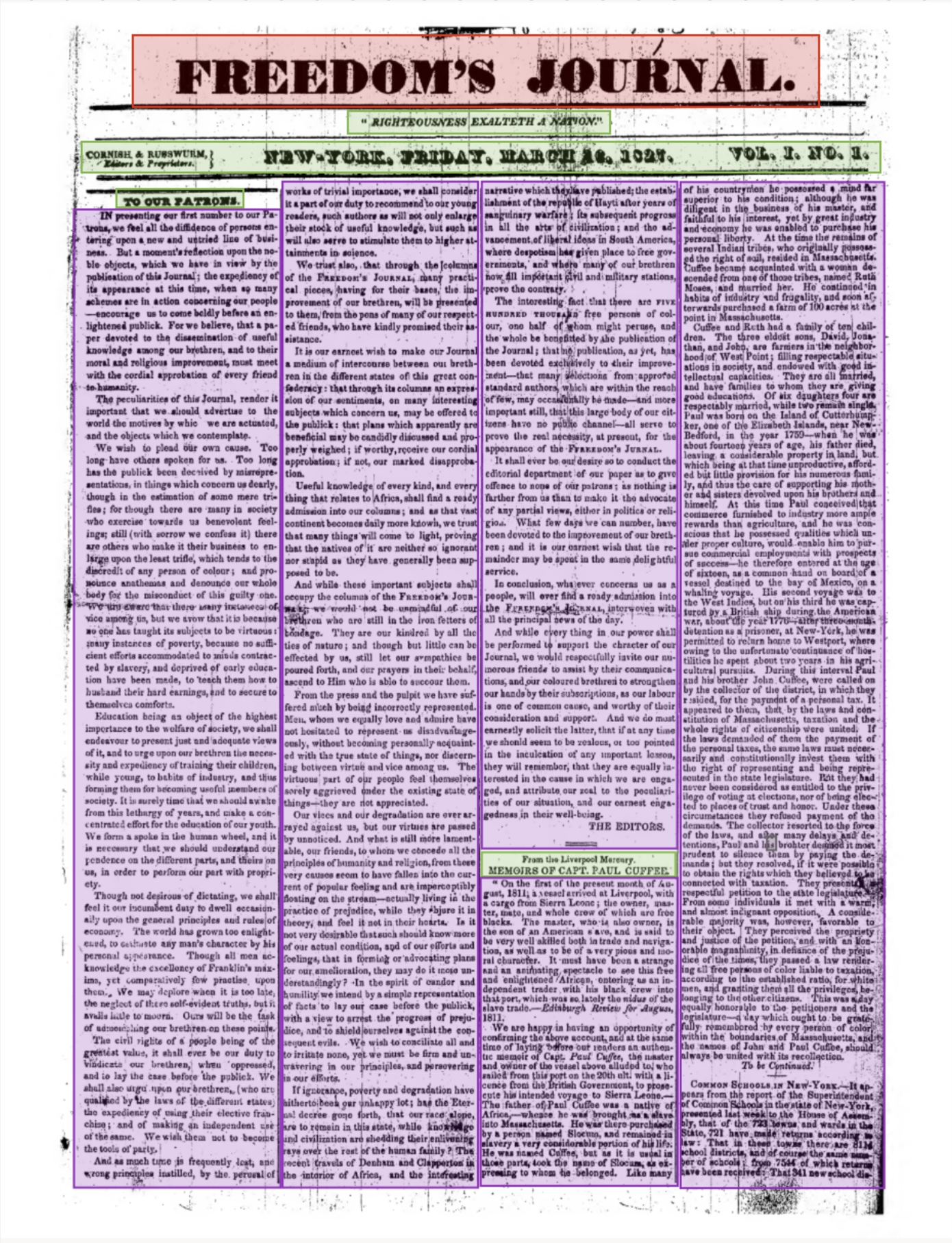
ABOVE: A machine learning model analyzes the page layout of the inaugural issue of Freedom’s Journal (1827), the first African American newspaper. As part of the “Communities in the Loop” project, the AI identifies different content types — such as headlines and articles — to prepare them for public transcription. (Image credit: Fitsum Beyene)
The University of California, Santa Barbara has been selected to lead a national research team awarded $750,000 from Schmidt Sciences’ Humanities and AI Virtual Institute. The grant will support “Communities in the Loop: AI for Cultures & Contexts in Multimodal Archives,” a project aimed at making the entirety of early African American newspapers more broadly and freely accessible to the public.
The interdisciplinary team, led by UCSB Assistant Professor of English Jim Casey, brings together expertise from ten universities and the Adler Planetarium to develop new AI tools that will help unlock scattered and fragmented archives of 19th-century Black newspapers. The project represents a fundamentally different approach to developing artificial intelligence for broader access to scattered materials — one that centers community participation and historical justice rather than corporate extraction and “black box” algorithms trained on biased data.
“Too long have others spoken for us”
For decades, the archives of the Black press have remained scattered across libraries or locked behind expensive paywalls.
“As the first Black newspaper, Freedom’s Journal, declared in 1827, ‘Too long have others spoken for us,’” said Casey, founding director of the Early Black Press Project. “We are not just adapting existing AI to read these archives. We are asking: What can the Black press tradition itself teach us about gathering, sharing, and transforming information? Early Black editors and journalists were innovating under slavery and Jim Crow — their methods have something profound to teach us about building better, non-extractive technology today.”
How it works: The “human in the loop”
Translating this vision into functional technology requires overcoming significant technical hurdles. According to Casey, current commercial AI tools are often trained on mainstream datasets that fail to account for historical nuances. As a result, these models struggle to accurately read the complex, experimental layouts of historical Black newspapers and frequently generate errors based on biased training data.
To address this, the UCSB-led team is developing machine learning models specifically trained on Black press materials to perform page layout segmentation and optical character recognition.
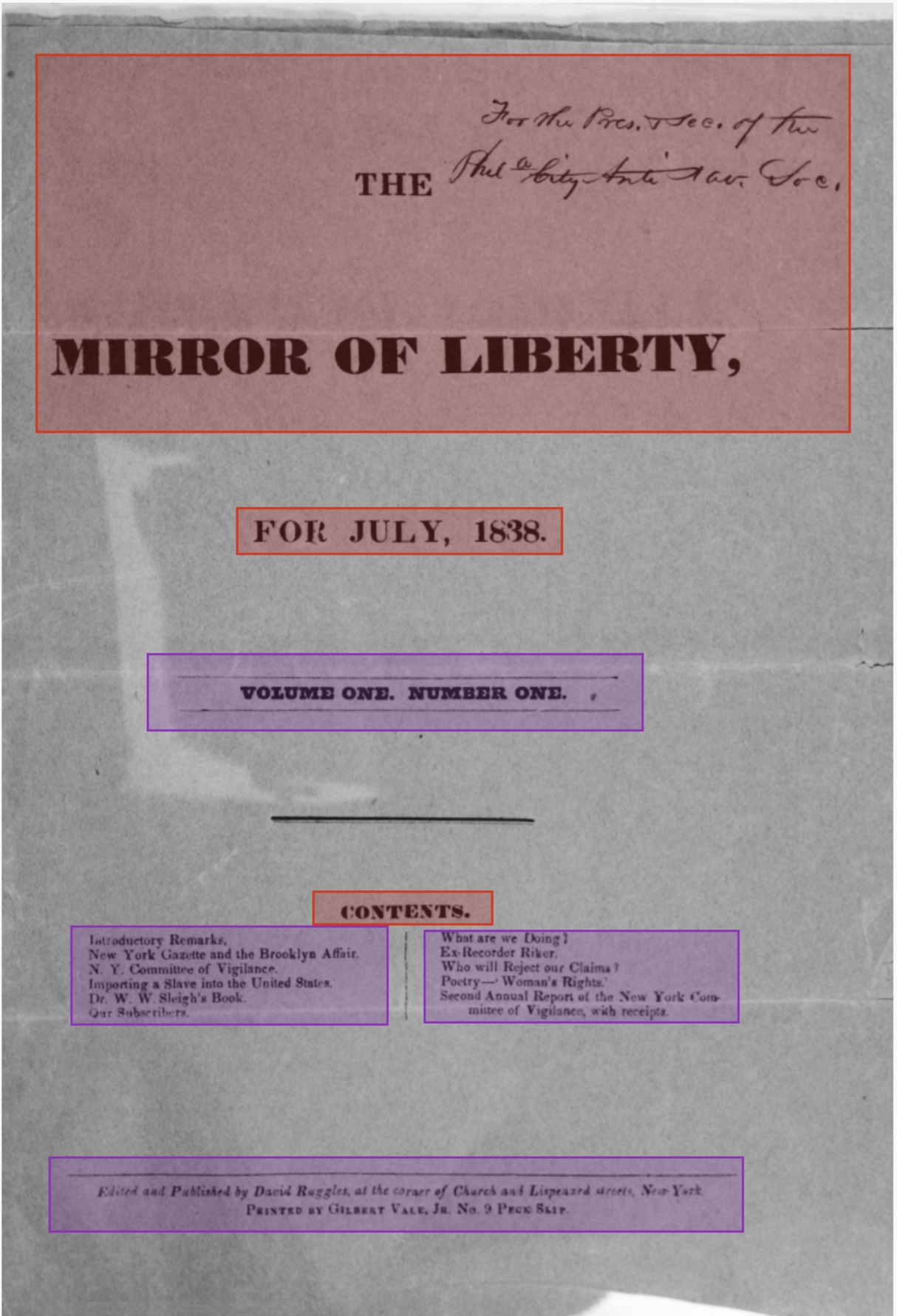
Red and purple boxes show page layout segmentation on a July 1838 issue of The Mirror of Liberty. The project trains AI models to navigate the complex and experimental layouts often found in 19th-century Black press archives, which commercial AI tools frequently misread. (Image credit: Fitsum Beyene)
These tools will prepare documents for Zooniverse, the world’s leading crowdsourcing platform. There, volunteers will validate and improve the machine-generated text — a process known as “human in the loop” — ensuring the history is preserved accurately while training the AI to be more culturally competent.
A national hub for Black digital research
The award accelerates the expansion of an award-winning set of projects and a national network Casey has established with his collaborator of more than a decade, P. Gabrielle Foreman, the MaCarthur-winning co-director of the Center for Black Digital Research at Penn State. At UCSB, Casey will build a West Coast hub for the Early Black Press Project, along with the long-running Colored Conventions Project and Douglass Day.
“Professor Casey’s work represents a vital convergence of historical inquiry and technological innovation,” said Daina Ramey Berry, the Michael Douglas Dean of Humanities and Fine Arts. “By bridging the gap between advanced computing and the humanities, this new project not only recovers crucial history but demonstrates how UCSB is leading the way in ethical, community-focused research.”
The leadership team
The grant fuels a deep collaboration across ten universities and the Adler Planetarium. The leadership team includes:
- Jim Casey (UC Santa Barbara), principal investigator, assistant professor of English and founding director of the Early Black Press Project.
- Christopher L. Dancy (Penn State), associate professor of industrial and manufacturing engineering, computer science and engineering, and African American studies, specializing in socioculturally competent AI systems; co-director, the Center for Black Digital Research.
- P. Gabrielle Foreman (Penn State), Paterno Family of Liberal Arts; professor of African American studies and history; co-director of the Center for Black Digital Research.
- Samantha Blickhan (Adler Planetarium), Zooniverse co-director and humanities lead.
- Tiffanie R. Smith (Lincoln University), chair and associate professor of computer science, focusing on culturally responsive computing education at HBCUs.
- Benjamin Charles Germain Lee (University of Washington), assistant professor in the Information School, exploring search and discovery for digital cultural heritage collections.
Looking ahead
The technology developed through this grant will power a massive public launch on Douglass Day 2027, coinciding with the 200th anniversary of Freedom’s Journal. The event will invite tens of thousands of participants to transcribe historical documents via a new mobile interface, removing barriers to entry and allowing anyone with a phone to help save Black history.
The result, Casey hopes, will demonstrate that “another version of AI is possible — one that doesn't have to be extractive, harmful or discriminatory. One that learns from communities who survived and resisted under impossible circumstances.”
About Schmidt Sciences
Schmidt Sciences is a nonprofit organization founded in 2024 by Eric and Wendy Schmidt that works to accelerate scientific knowledge and breakthroughs with the most promising, advanced tools to support a thriving planet. The organization prioritizes research in areas poised for impact including AI and advanced computing, astrophysics, biosciences, climate and space — as well as supporting researchers in a variety of disciplines through its science systems program.
Schmidt Sciences has awarded $11 million to 23 research teams globally through the Humanities and AI Virtual Institute (HAVI). These interdisciplinary teams are exploring new ways to bring artificial intelligence into dialogue with the humanities while drawing on humanistic questions, methods and values to advance how AI itself is designed and used.
Related Links
● Schmidt Sciences HAVI Announcement: schmidtsciences.org/havi-2025-announcement
● Douglass Day: DouglassDay.org
● Colored Conventions Project: ColoredConventions.org
Editor’s Note: While this grant prepares for the 2027 bicentennial launch, UCSB will host a local Douglass Day 2026 event on Friday, Feb. 13, 2026, focusing on the Colored Conventions Movement. Additional details regarding local coverage and participation will be shared closer to the event date.