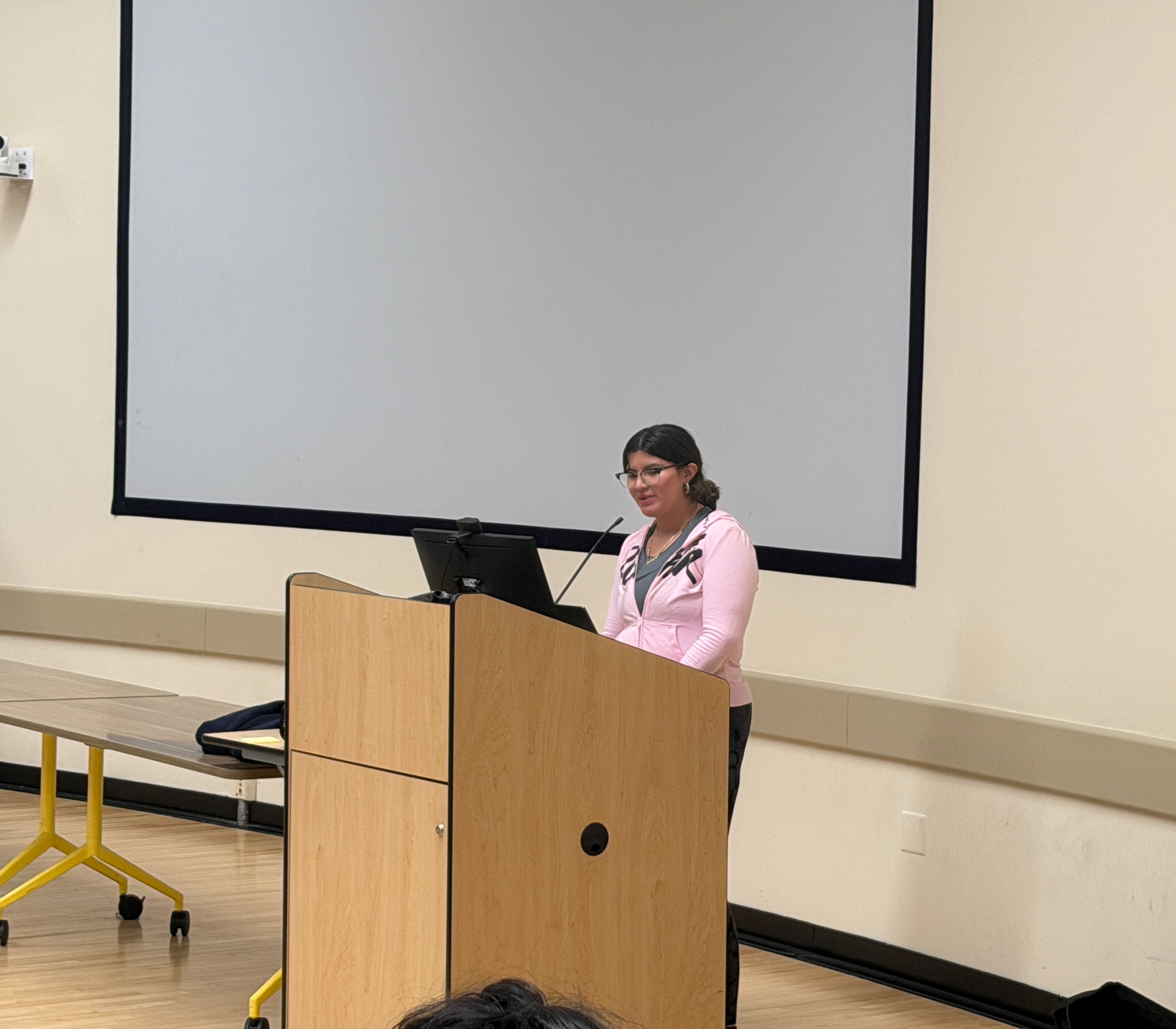
For nearly two decades, a unique correspondence program has empowered first-generation students on both sides of the exchange to see themselves in higher education.
(Above) UC Santa Barbara undergraduate Irma Carolina Rodriguez reads a letter to visiting students during the annual pen pal exchange. Rodriguez stepped in to read on behalf of a fellow mentor, ensuring every student received a warm welcome to the university.
The nerves were palpable as the buses pulled up to UC Santa Barbara’s campus on a Monday afternoon in early December. Sixty-five middle school students from R.J. Frank Academy of Marine Science and Engineering in Oxnard, Calif., stepped onto the grounds of a university many had never visited, clutching letters they’d written to college students they were about to meet for the first time.
Inside the Student Resource Building’s multipurpose room, 65 UCSB undergraduates waited with equal anticipation. For three months, they’d exchanged handwritten letters with these sixth- and seventh-graders, sharing stories about everything from raising goats to future goals, homesickness and hope. Now, the words on paper would become faces, voices and pizza-fueled conversations about what it means to reach for college — and make it.
“For many of my students, it’s the very first time they’ve ever stepped on a college campus,” said Summer McMeekin, a sixth-grade teacher at R.J. Frank Academy and herself a UCSB alumna. “Hearing their story inspires them. They realize, ‘I can do this too, I belong, and this is something that can be my reality.’”
A partnership with deep roots
What began in 2004 as the “Writing Everywhere Collective” — with writing program faculty working with several Oxnard schools — has evolved into a focused, enduring partnership. In fall 2008, Writing Program faculty members Robert Krut and Ilene Miele first visited R.J. Frank Academy, launching the collaboration that continues today. Seventeen years later, the program remains a bridge between aspiration and achievement.
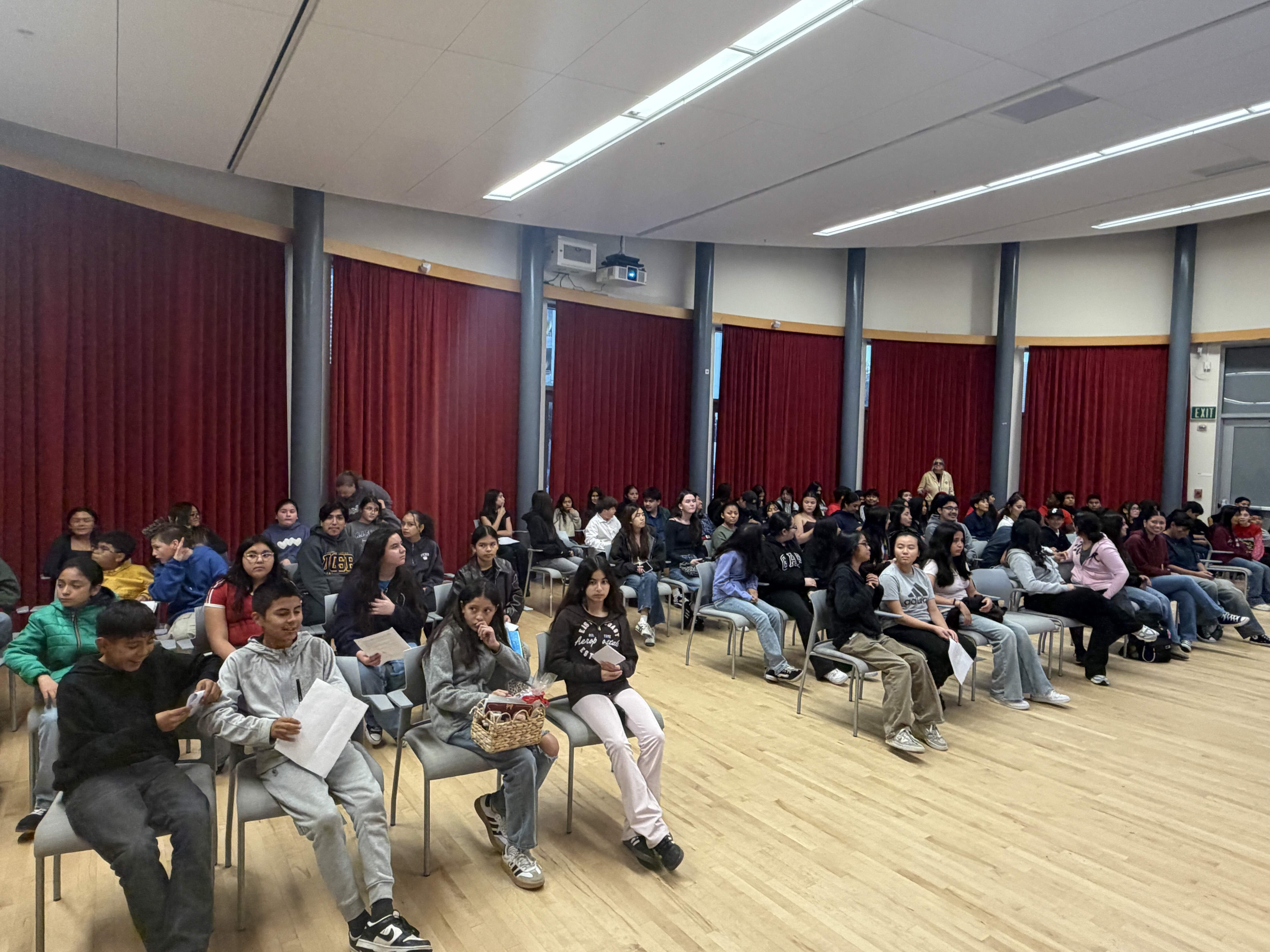
Sixth and seventh-grade students from R.J. Frank Academy listen intently inside the Student Resource Building. The visiting students are part of the AVID college-readiness program, while their mentors come from UCSB's Academic Communities of Excellence (ACE).
The partnership is intentionally designed to pair students with shared backgrounds. The middle school students participate in AVID (Advancement Via Individual Determination), a national college-readiness program serving first-generation students. Their UCSB counterparts are enrolled in the Academic Communities of Excellence (ACE) track — smaller writing courses specifically for Educational Opportunity Program (EOP) students, who are typically from lower-income families and underrepresented communities. Many ACE students were themselves AVID participants in middle school.
“It’s a full circle moment,” explained Jennifer Johnson, associate director of the Writing Program. “By the time our students arrive on campus in the fall, many are feeling homesick and overwhelmed. Then they receive these letters from middle school students asking about college life, and it reminds them that they were once exactly where these kids are — dreaming about being at a university. It helps them reframe themselves as success stories.”
From letters to lives
The exchange begins each fall when Johnson and colleague Nicole Warwick visit R.J. Frank Academy to introduce the program. They share their own journeys to college, lead writing exercises and help students craft their first letters. Before the visit, both groups watch a video about the first-generation college experience, giving them a shared reference point and an academic framework for their correspondence.
“This is what happens at a university,” Johnson tells the middle school students. “They talk about ideas and think about things they’re learning about together.”
Each UCSB student is paired with one middle school pen pal. Over the quarter, they exchange three rounds of letters — first delivered by hand, then via email. The correspondence covers everything from practical questions about dorm life and class schedules to deeper reflections on family, identity and what it takes to get to college.
For UCSB student Irma Carolina Rodriguez, the letters bridged two very different worlds. “I’m from an unincorporated community, so college was never really in the question,” Rodriguez said. “Hearing my pen pal already thinking of college in middle school was amazing to see because I was not thinking like that in my situation.”
Rodriguez discovered common ground with her pen pal through an unexpected topic: her family’s goat business back home. “She had never heard of that, so I got to show her what it looks like back in my hometown to raise goats,” Rodriguez said. The exchange revealed how university students carry their communities with them — and how those experiences can inspire others.
McMeekin, who is the first in her family to graduate from college, sees the program through both professional and personal lenses. “I never stepped foot on a college campus until my senior year,” she said. Now, she ensures her students don't wait that long to envision their futures in higher education.
A moment of recognition
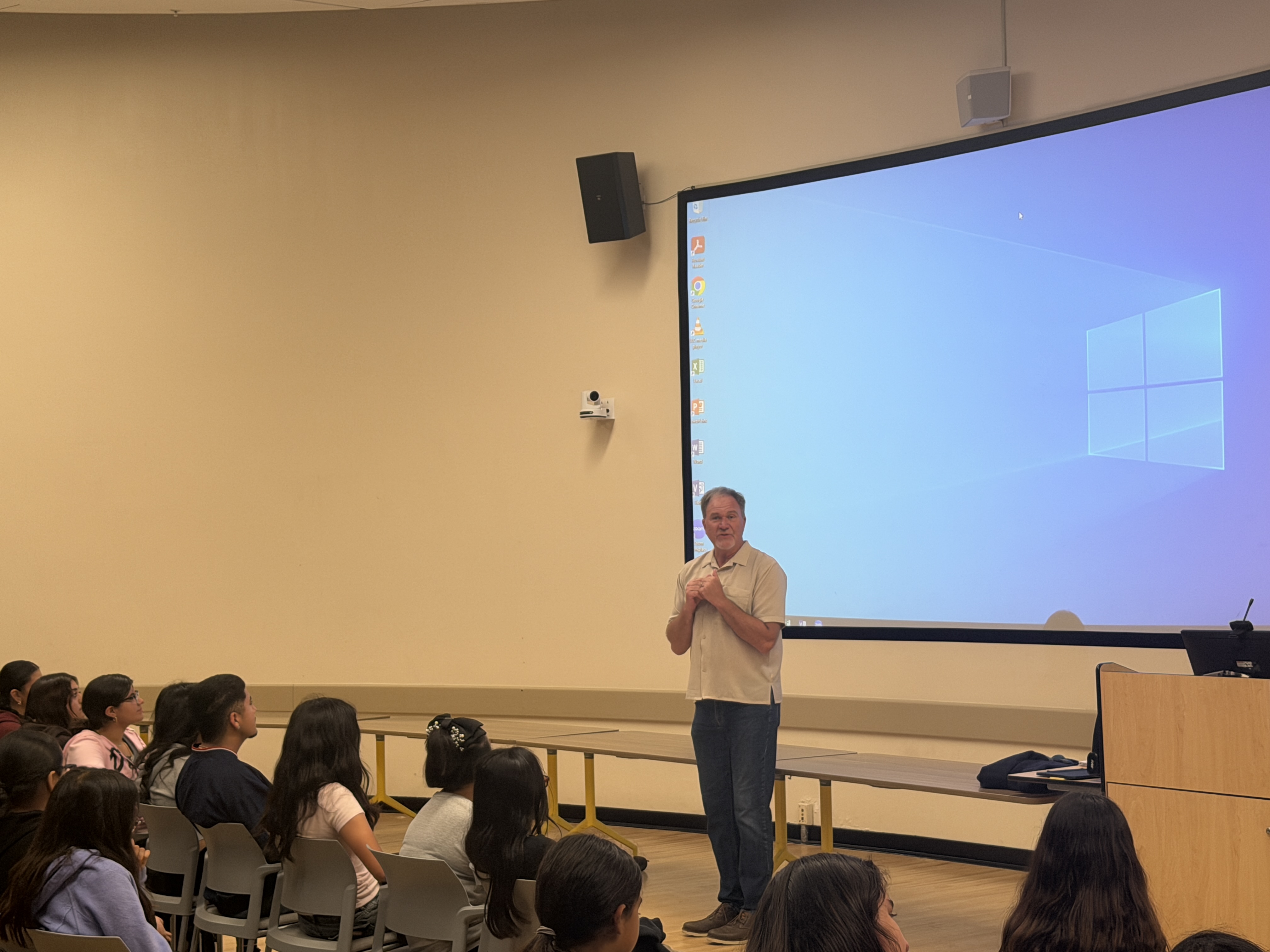
Writing Program Director Paul Rogers welcomes students from R.J. Frank Academy of Marine Science and Engineering to the UCSB campus. Rogers kicked off the event by encouraging the middle schoolers to see themselves as future university scholars.
The program culminates in the annual campus visit, where digital communication gives way to the tactile power of handwritten words. The event opened with a warm welcome from Writing Program Director Paul Rogers, followed by a video presentation by Patricia Morales Rojas. A former Writing 2 student and first-generation scholar, Morales Rojas spoke to the students about overcoming shyness and the importance of asking for help. “You’ll never know if you don’t ask,” she told the room, urging them to lean on their counselors and mentors. During the shared reading session that followed, UCSB student Jazmin Rodriguez read a letter that offered reassurance to sixth-grader Jazmin Torres about the pressures of growing up.
“You are already doing it — helping your parents, cooking, staying on top of school. You are already learning how to manage responsibilities on your own,” Rodriguez read aloud. “That is exactly the type of experience that will make your transition easier in the future.”
Torres responded with clarity about her own aspirations: “My dream is to be successful in life so I can pay back my parents and siblings everything they deserve because they have helped me so much.”
The visit includes a campus tour led by Krut, with ACE student volunteers serving as guides. Christopher Dean, another Writing Program lecturer who has participated in this event for years, meets the buses as they arrive. After the letter reading, students share pizza and conversation, transforming pen pals into people.
A legacy that endures
Despite budget fluctuations and changing educational landscapes, the program has persisted through nearly two decades of evolution. From its origins as a broader community initiative to its current targeted partnership, it has remained responsive to student needs while maintaining its core mission.
“Through every ebb and flow — financial, socio-political or educational — it’s still here,” Krut said.
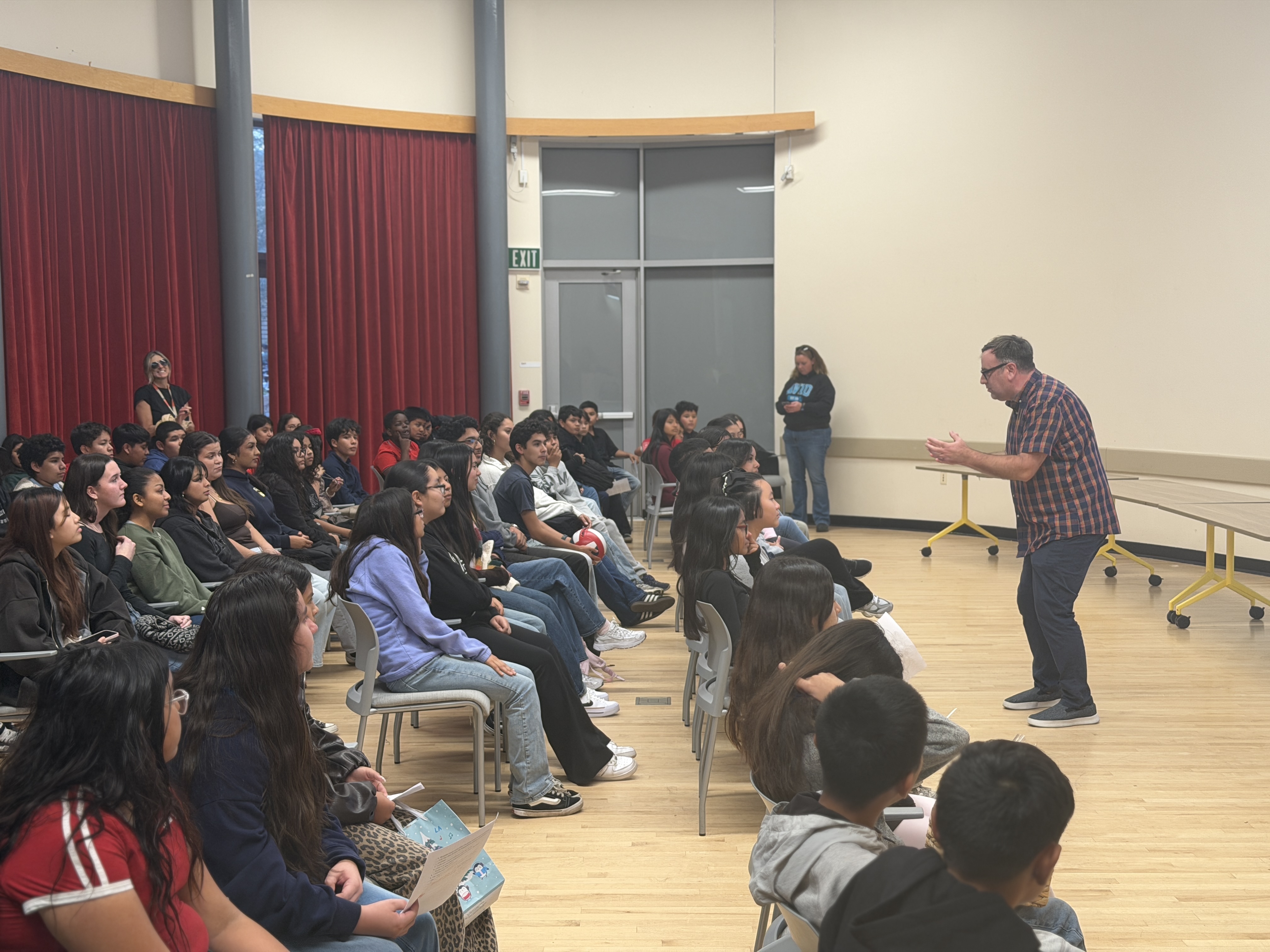
Faculty member Robert Krut engages with the visiting students. The event, which began as a partnership in 2008, serves to demystify higher education and prove to students that they belong on a university campus.
For the UCSB mentors, the experience often provides an unexpected boost of confidence just as they approach finals week. The recognition that they've become role models, that their presence at the university matters to someone else, carries weight.
“It gives me a lot of motivation,” Irma Carolina Rodriguez said. “There are kids out there looking up to me. As students here, we should make them proud.”
That sense of responsibility runs both ways. The middle school students arrive on campus and see their futures reflected in faces that look like theirs, hear stories that sound like their own and leave knowing that the path to higher education, while challenging, is one they can walk.
After the buses depart and the pizza boxes are cleared away, what remains are the letters themselves — evidence that connection, encouragement and the simple act of writing to one another can build something that lasts. For 17 years and counting, this partnership has demonstrated that sometimes the most powerful interventions are also the most human: one student, one letter, one relationship at a time.