
UC Santa Barbara art historian Alida Jekabson co-edits a forthcoming Bloomsbury anthology examining craft as a form of memory, resistance, rehabilitation and survival during war.
In the aftermath of World War II, inside a displaced persons camp in the British Zone of occupied Germany, Alida Jekabson’s paternal grandmother worked as a scout leader, teaching young people craft practices and survival skills.
Decades later, Jekabson found herself studying the material traces of that world, including national dress pattern books sent to her family from the Soviet Union and clippings about Latvian American communities continuing those traditions after resettlement.
For Alida R. Jekabson, a doctoral candidate in the Department of History of Art & Architecture at UC Santa Barbara, these materials became more than family records. They became historical evidence.
“War doesn’t just happen on the battlefield,” Jekabson said. “It reaches into people’s lives and into their spaces.” For Jekabson, that means understanding war not only through battles or date ranges, but through the materials, practices and communities shaped by conflict.
That understanding of material history informs Jekabson’s work as co-editor of “Craft and War: Makers, Users, and Craft Practices Since the 19th Century,” a forthcoming peer-reviewed anthology from Bloomsbury Visual Arts. Co-edited with Jennifer Way and Heather Smith, the 352-page volume is scheduled for publication June 11 and brings together 16 chapters on craft’s role in war and its aftermath.
From panel to publication
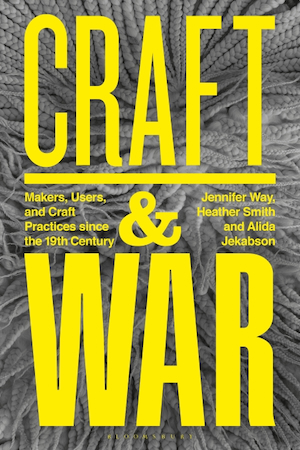
The project’s origins trace back to 2019, when Jekabson was working in the curatorial department at the Museum of Arts and Design in New York. She responded to a call for papers for an Association for Art History conference panel on craft and war, organized by Way.
The panel, originally planned for spring 2020, was delayed by the COVID-19 pandemic and later held online. Still, Jekabson said, the conversation proved generative. Participants were studying subjects ranging from World War I Red Cross quilts to Cold War feminist craft networks. The breadth of the work suggested that the intersection of craft and war warranted a larger scholarly platform.
Jekabson, Way and Smith eventually expanded the project into a full anthology. The process involved soliciting proposals, reviewing submissions, working with contributors through multiple rounds of revision, preparing the manuscript for blind peer review and navigating the logistical work of publication, including image permissions and credits.
“I would like to think that this experience made me a better writer,” Jekabson said.
Editing other scholars’ work over several years sharpened her own writing, she said, particularly her ability to identify what readers most need to know.
“Like many graduate students, I am an over-researcher,” she said. The editorial process helped her focus on “what really is important for my reader.”
Craft beyond the battlefield
The resulting book challenges a long-standing hierarchy that has often treated craft as secondary to fine art. Instead, the anthology treats craft as a vital way to understand survival, diplomacy, rehabilitation, displacement, resistance and memory.
By bringing craft studies and war studies together, the book shifts attention away from traditional accounts centered on military leaders, treaties and battlefield scenes. It focuses instead on makers, materials and objects that reveal how conflict is experienced and embodied.
“These are makers and objects that, again, are not the big history paintings,” Jekabson said. “They’re not often talked about as important to understanding war.”
For readers, Jekabson hopes the anthology opens new ways of thinking about both historical and contemporary conflicts.
National dress and displacement
For her own chapter, “Passing the Thread: Craft and Latvian National Dress in Post-War Displaced Communities,” Jekabson looked to her family history. Her father spent much of his childhood in a displaced persons camp outside Hamburg after his family was forced to leave Latvia. He later immigrated to California with his family.
Jekabson’s research examines how displaced Latvian communities used national dress as a tangible expression of identity. While scholarship on Latvian displaced communities has often focused on song and dance traditions, Jekabson became interested in the dress worn as part of those cultural practices.
“These are histories that are informing why this national dress is important in these refugee camps,” she said. “It was a tangible way to express identity.”
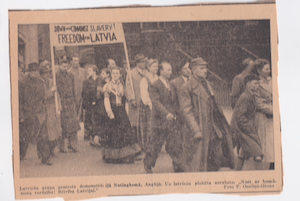
(7.3) Group of Latvians protesting in Nottingham, England, undated clipping c. 1950, publication unknown. Courtesy Private Collection.
As her research deepened, Jekabson found that national dress was not only a tool for cultural education within displaced communities. It also became part of a broader strategy of self-representation. In the postwar period, as displaced people sought resettlement in countries such as the United States, these craft traditions helped Latvian communities present themselves in ways that would be legible to Western audiences during the early Cold War.
The garments also revealed the material realities of displacement. Some dresses woven in camps were made from unraveled army blankets, Jekabson said, while some refugees built looms from bombing rubble.
“They were taking these materials and creating something for themselves,” she said.
A continuing thread
The work also connects to Jekabson’s dissertation, “Moral Materials: Modern American Textiles, Consumer Culture and the Value of Craft.” Her dissertation examines 20th-century textiles in the United States and in places where the United States was occupying, intervening or exerting influence. She is especially interested in how textiles mediate ideas of morality, value, humanitarianism and consumer responsibility.
One part of that research looks at American Jewish humanitarian and charitable organizations that provided vocational and rehabilitative training to Jewish refugees in displaced persons camps after World War II. Those programs included craft skills such as tailoring and shoemaking, and some of the resulting textiles were later exhibited in U.S. department stores.
For Jekabson, those displays were not simply evidence of need. They also presented refugees as skilled makers whose work could communicate resilience, value and potential belonging, and contribute valuable skills to the U.S. economy.
At UC Santa Barbara, Jekabson said, the anthology and her chapter were shaped by doctoral seminars, conversations with faculty and professional development opportunities focused on publishing and curatorial work. She credited the guidance of Jenni Sorkin, professor and chair of the Department of History of Art & Architecture, as well as feedback from faculty and peers across the department.
“I would not have been able to complete this without being at UCSB,” Jekabson said.
Her research has also extended beyond the archive. For the past year and a half, Jekabson has taken a weaving class at UC Santa Barbara’s Recreation Center with local textile artist Julia Ford, where she has been able to weave some of the designs she studies.
That hands-on practice, she said, has offered a meaningful complement to her scholarship.
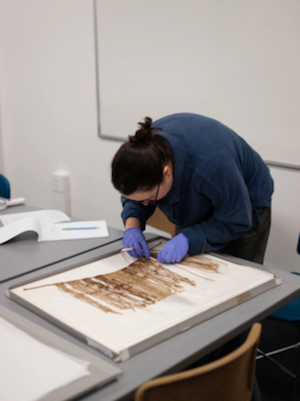
Jekabson also worked on “Haptic Khipu,” a collaborative online exhibition about a khipu in the collection of UC Santa Barbara’s Art, Design & Architecture Museum. A khipu is a knotted-fiber record-keeping device from the Andean region, most commonly associated with the Inka Empire. The project uses material, haptic and digital imaging methods to examine how knowledge can be encoded in fiber and form. Technical analysis, including radiocarbon dating, revealed that the dates of the khipu at UCSB intersect with the beginning of Spanish colonization in the region.
The project reflects Jekabson’s broader interest in how fiber can transmit knowledge across cultures, geographies and historical periods.
“Sometimes when I talk about my work, it’s like, ‘Oh, but you work on early modern Latin American textiles, and you’re working on these postwar Eastern European textiles,’” Jekabson said. “Yes, these materials or histories might seem far apart, but the role of fiber is — to be punny — like a continuing thread.”
Scholarship in collaboration
Jekabson has also brought that collaborative approach to public-facing work, including curatorial writing for “Fault Lines,” the 2026 Master of Fine Arts thesis exhibition at the Art, Design & Architecture Museum.
Although doctoral scholarship is often framed as an individual pursuit, Jekabson said the anthology, exhibition work and digital humanities projects have reinforced the importance of collaboration.
“Doing things in collaboration and in concert with one another, I think I’ve learned, is a really important skill,” she said.
With “Craft and War” moving from conference panel to published volume, Jekabson said the project feels both like the culmination of years of work and the beginning of what comes next.
“It’s really exciting,” she said. “I feel that this is sort of just the beginning.”